
What to Know About
Launching a Mid-Year
High-Impact Tutoring Pilot
School budgets are often uncertain, leaving leaders waiting sometimes until October to secure funding for the high-impact tutoring programs they want to start. It’s not too late to get a program started in the middle of the year, but it’s important for districts and schools to think about both the advantages and the challenges of launching mid-year.
A mid-year tutoring pilot can offer a chance to test tutoring in preparation for a full program launch in the fall, identify essential components for program setup, and build buy-in with teachers, students, and potential funders and community partners.
We understand how important it is to get these programs right. With over 10 years of experience supporting high-impact tutoring programs across the U.S., we’re eager to share our tips for successfully implementing mid-year tutoring pilots.
Exploring the Essential Components of a Mid-Year Launch
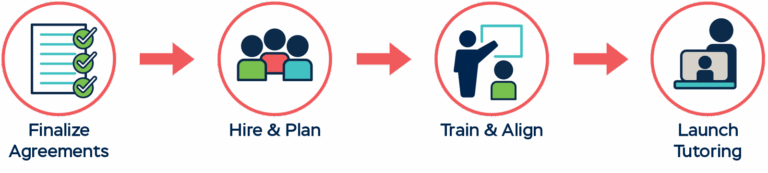
Before launching a mid-year pilot, school districts should thoroughly vet their tutoring partner. Regardless of the program’s size, “you want to evaluate the tutoring provider along the same criteria that you would if it was one school versus 50,” says Maryellen Leneghan, Saga Education’s Chief State and District Partnerships Officer. Make sure the tutoring partner has strong evidence backing their approach, that they provide tutors with excellent training, and they have high-quality instructional materials. For a mid-year launch, schools should aim to finalize agreements in November and plan for an early February start.
Sample Timeline for a Mid-Year Tutoring Launch
An advantage of starting a high-impact tutoring pilot program in the middle of the year is that it allows you to think about scaling and future expansion. As Leneghan shares, “A mid-year pilot allows you to test out your scheduling, hiring structure, the buy-in from staff, and alignment to teachers and curriculum.” It helps district leaders consider what needs to be in place for a successful full-year program launch.
Tutoring pilots vary in size, but it’s important not to make them too small, says Chris Dupuis, Saga Education’s Chief of Direct Service Programs. “Having one tutor come in to work with 10 students is not a good pilot if you’re looking to run something more rigorous the following year. Be thoughtful about what end you have in mind and make sure the pilot represents a downsized version of that final vision.”
A more impactful approach, for example, would be for rural districts to focus on one grade in one or two schools, while large suburban and urban districts typically involve two to four schools. This approach can provide school teams and partners with the chance to reflect and adjust their plans for fall.
Find the Right School Leader to Drive the Pilot
Individual school leaders play a vital role in the success of a tutoring pilot. Leneghan suggests identifying principals and other school leaders who are not only influential among their peers but also genuinely willing to offer honest feedback about the program.
“If you do this, you’ll be able to get them talking about how great the program was and recruit additional school leaders while also getting the real feedback you need about the successes and challenges they’ve experienced for the upcoming year,” Leneghan explains.
Dupuis adds that entrepreneurial school leaders—those early adopters who quickly achieve great, positive results—are key to a pilot’s success. He also suggests districts look for a math team that has been effective at adopting past programs and is willing to co-design and co-plan with a tutoring partner.
“A mid-year pilot allows you to test out your scheduling, hiring structure, the buy-in from staff, and alignment to teachers and curriculum.”
Maryellen LeneghanChief State and District Partnerships Officer, Saga Education
Carefully Select Schools and Students
Leneghan recommends that districts avoid placing a tutoring pilot in their most struggling schools, suggesting instead to introduce the program to them after lessons have been learned from the pilot.
She advises introducing it where it can be the least disruptive to the current school schedule. If the school already has students grouped in intervention periods or doing some sort of pullout as part of their schedule, those could be potential places where tutoring could fit in. At some schools, students switch electives in the middle of the year, and this can be a good opportunity to direct students into tutoring as an elective.
“Most schools cannot change their master schedule mid-year, so you want to pick schools that have a place where tutoring can already fit into the schedule,” Leneghan says. Dupuis adds that schools without intervention periods could still consider embedding tutors in classrooms alongside teachers.
Strategic student selection is another key aspect of running an effective mid-year tutoring pilot. Leneghan and Dupuis recommend selecting students who are right on the cusp of readiness.
“If I were a principal, I would recommend selecting students who are just below the readiness cusp—in the third quintile—and see if I can jump them up in one semester above that readiness cusp,” Dupuis says.
Innovative Approaches, Flexibility, and Funding
A mid-year pilot can also serve as a way to engage potential funding partners. A district might pursue seed funding from a community foundation to demonstrate the effectiveness of tutoring. Some foundations are mainly interested in funding a pilot versus a full program, noted Leneghan.
Schools could also use a pilot to engage funders in discussions for follow-on funding for the full program. Districts could, for instance, propose a metric to local philanthropies that would unlock additional funding. For example, if the pilot achieves targeted results, the donor or foundation would fund a larger-scale program. Metrics don’t necessarily need to be tied to student outcomes. Leneghan notes that there are many other options for metrics, such as tying success to principal and teacher testimonials or the dosage students receive.
Beyond external funding, a pilot can be a valuable tool for internal program design and readiness. Schools can also consider implementing their own tutoring pilot to identify their needs and understand their readiness for investing in a full program. Saga has worked with school partners who took this step and used the pilot to help design their request for proposals (RFPs).
Leneghan says that one school district reviewed evidence on tutoring and then initiated a four-month trial in two schools. Meanwhile, they developed the RFP for vendors to determine their needs.
The district discovered they could hire the tutors but needed a partner to conduct the training and provide curriculum. They also used the pilot to figure out the scheduling logistics. The pilot helped the district plan for scaling—from two schools in the pilot to 20 in the second year.
Dupuis adds that for districts not yet ready for a mid-year pilot, they could run scenarios to integrate tutoring into their existing systems. Since scheduling is often a challenge, teams should explore scenarios for fitting tutoring into their ecosystem. He emphasizes this type of planning is key when discussing options with potential providers.
Expectations and Outcomes
Some schools may want to explore outcomes-based contracts for tutoring programs, which offer a way to ensure clear, shared metrics and outcomes with partners. However, it’s critical to remember that launching a mid-year pilot will deliver half the dosage. Leneghan recommends reserving outcomes-based contracts for the full-scale fall rollout. If districts pursue an outcomes-based contract for a mid-year start, the outcomes must be relative to the start time and the actual amount of tutoring students will receive.
“A mid-year start allows the district to outline what are the actual parameters for their outcomes-based contract that they are going to launch,” she says. “There’s nothing wrong with having an outcomes-based contract for a mid-year start—it’s just that your outcomes have to be realistic to the time frame that the program is going to be operating.” She adds that districts should make clear with partners that they expect the relationship to shift to an outcomes-based contract in the fall, measuring attendance, student growth, and so on.
Dupuis emphasizes the importance of looking more holistically at outcomes. “If districts really want to study a tutoring program in a pilot, they shouldn’t just set a target that X number of students are going to pass the state exam at the end of the school year,” Dupuis says.
Prior to launching any tutoring program, schools should observe students and conduct student surveys. This provides a baseline, allowing the program to look for qualitative factors like increased student confidence in math skills. “Are they raising their hand in class? Contributing to class discussions? Is the teacher’s perception of students changing because students are showing up in a different way to class?,” he says.
“There are so many other things that schools and districts can look at because you’re talking about a semester of dosage, and there are start-up costs that can affect the outcomes of a mid-year pilot—especially if you’re bringing in a new group of tutors who haven’t tutored before.”
Fostering Teacher and Student Buy-In
Leneghan notes that student and teacher buy-in are key challenges to overcome in a mid-year tutoring pilot. Students have already established a routine, so tutors may have more relationship-building to do. Teachers also may be more apprehensive because tutoring is being introduced mid-year. These challenges can be overcome by clearly communicating the “why” behind tutoring and what the district will learn from it, she says. Offering students incentives to participate can also help with buy-in.
Ultimately, a mid-year tutoring pilot’s true power is it provides a lower-stakes opportunity to gather real feedback and make critical program adjustments. This learning experience can be key to securing funder interest and ensuring a successful, full-scale launch in the fall.