
High-impact tutoring (HIT) delivers the results schools need, accelerating student learning and closing equity gaps. Drawing from the recent EdWeb Webinar, “Turning Around Schools with High-Impact Tutoring,” moderated by Saga Education CEO Alan Safran, we highlight five strategic levers that make HIT programs successful and sustainable.
Dosage and Quality: The Formula for Impact
At the heart of high-impact tutoring’s effectiveness is a simple, yet powerful formula: dosage multiplied by quality equals impact. As Safran noted, low-dosage tutoring for students who are far behind grade level—like the 18–20 hours observed in one example—inevitably leads to low impact, no matter how good the tutoring quality. Safran said that research and practical experience point to a minimum of 55 hours as the “sweet spot” for most students to see meaningful academic gains. Districts must prioritize this commitment to sufficient, consistent instructional time to realize the potential of their tutoring programs.
Relationships: The Game Changer
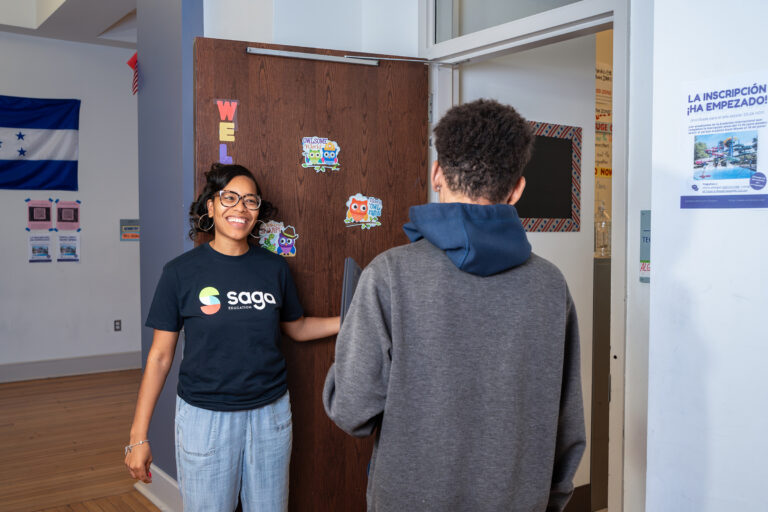
The core principle driving successful HIT programs is relationships: “Kids don’t care how much you know until they know how much you care.” The small-group relationship between the tutor and the students is the “game changer,” noted Katie Tennessen-Hooten, founder and senior vice president of the Ignite Fellowship at Teach for America. This bond fosters trust, increases student engagement, and serves as the emotional foundation for academic risk-taking. Programs like Teach For America’s Ignite Fellowship leverage this by recruiting college students as peer tutors, not only supporting K-12 students but also creating a direct “tutor-to-teacher pipeline” as tutors discover a passion for the profession.
Sustainable Funding Requires Evidence and Leverage
Sustaining a high-impact tutoring program means moving beyond short-term grants by leveraging multiple federal funding streams—such as Title I and Federal Work-Study—and pairing this strategy with “rigorous, multi-faceted evidence.” Dr. Christina Grant, previously the State Superintendent of Education for the District of Columbia, shared that in Washington, D.C., the successful argument for integrating HIT into the local operating budget was based on data showing not just academic growth, but also “positive social-emotional wellness” and the successful “tutor-to-teacher pipeline.” Grant, now the executive director of the Center for Education Policy Research (CEPR) at Harvard University, noted that robust research, often in partnership with organizations like the National Student Support Accelerator (NSSA), is crucial to demonstrate impact and secure long-term investment.
Live Online Tutoring: A Viable, Reliable Mode
For districts struggling with staffing or logistics, live-online tutoring has proven to be a highly viable and impactful option. The research is increasingly showing that the modality (virtual vs. in-person) is less important than the drivers of impact: dosage, reliability, and quality. Live-online models often result in higher dosage because they remove geographical barriers and increase scheduling flexibility for tutors, Tennessen-Hooten said. While AI is a powerful tool, it’s best utilized to “scale quality”—providing feedback and operational support to tutors and site leaders—rather than replacing the essential, “game-changing” human relationship.
Systemic Change Means Resource Reallocation
To achieve systemic change, districts should stop clinging to “legacy resource structures”—those allocations of time, money, and staff based on tradition instead of evidence.
Jess O’Connor, who leads Education Resource Strategies’ School Design Practice Area, outlined a three-step process for successful adoption:
- Develop a clear, evidence-based plan.
- Analyze current resource use to identify opportunities for reallocation (e.g., re-evaluating class sizes, schedule time, or staffing roles) that can fund HIT.
- Obsessively monitor and adjust based on implementation data.
Most initiatives fail not because of a lack of effort, but because the resources are not aligned to support the new, high-impact strategy.
By focusing on these five strategic levers, school systems can build high-impact tutoring programs that deliver substantial and sustainable educational transformation.
To dive deeper and hear directly from the experts, watch the full webinar, “Turning Around Schools with High-Impact Tutoring,” available on EdWeb.
Ready to transform student outcomes with high-impact tutoring?
Learn more about how this long-term investment can reshape academic success for your students.