
Partnerships and Progress:
Milford’s Math Tutoring Club
Elevates Student Learning

Milford Public Schools
Milford, Massachusetts
Executive Summary
Milford Public Schools’ math tutoring program, driven by a community partnership, significantly increased student math achievement and attendance. Key factors include strong community support and the effective use of virtual corporate volunteers.
Key Takeaways
- Milford Public Schools boosted student math growth and attendance through a partnership with the Community Foundation for MetroWest, Saga Education, and Life Science Cares Boston.
- Success was driven by community collaboration, virtual volunteers, and a team-based model that emphasized real impact.
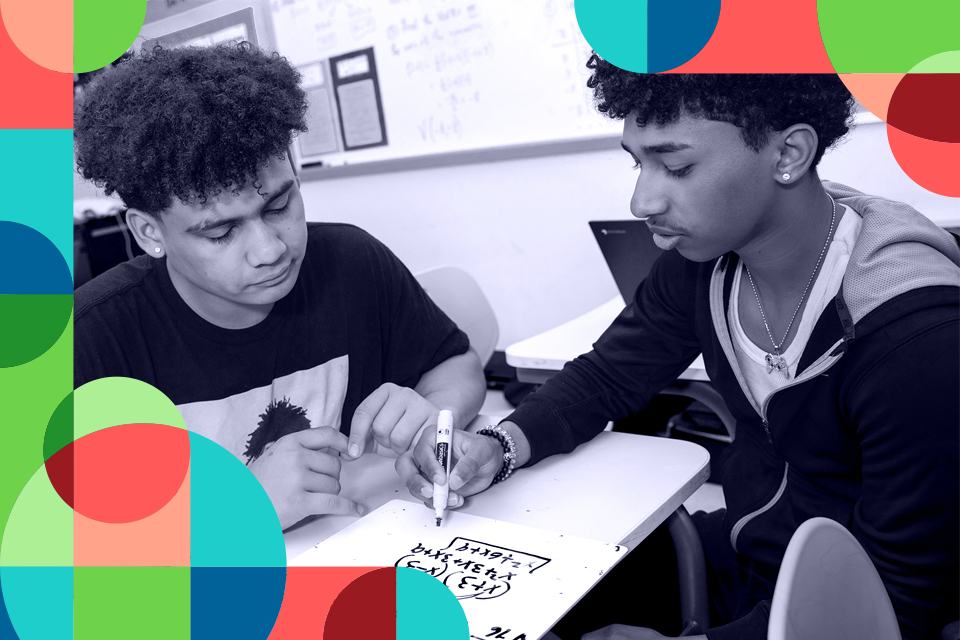
Milford Public Schools, in partnership with the Community Foundation for MetroWest, Saga Education, and Life Science Cares Boston, has successfully implemented a high-impact math tutoring club for sixth and seventh graders. Now in its second year, this initiative is helping students accelerate their math skills, demonstrating how smaller districts can effectively adapt high-impact tutoring to meet student needs and create sustainable programs.
Maryellen Leneghan, Saga Education’s Chief State & District Partnerships Officer, highlights Milford’s program as a model for managing volunteer tutors and achieving significant student gains
Strong Gains from Focused Tutoring
In the 2024–25 school year, 40 students at Stacy Middle School participated, receiving over 750 hours of tutoring.
The results were compelling:
- 47% of tutored students met their typical math growth goal, compared to 40% of their peers not in the program.
- 29% met their stretch growth goal, significantly higher than the 14% of peers.
- Tutored students showed a 1% higher attendance rate, equal to about two extra school days.
Community Support Makes the Difference
The program’s success is largely due to strong community support. The Community Foundation for MetroWest funds the initiative, while tutors are corporate volunteers who are recruited and managed by Life Science Cares Boston. These volunteers, who are professionals from across the life science industry, dedicate at least 30 minutes per session, using Saga Education’s online tutoring platform, Saga Connect.
The program was first launched after the Community Foundation for MetroWest, using data from its Impact MetroWest platform, identified significant achievement gaps in third-grade reading and eighth-grade math among students of color. Matt Jose, the Foundation’s director of programs, explained that the interactive platform offers a comprehensive snapshot of the region’s 700,000 residents.
After reviewing Milford Public Schools’ needs, district leaders targeted sixth graders for tutoring. Kerry Taylor, Milford Public Schools’ interim assistant superintendent for teaching and learning, noted that sixth grade was selected, as students in this grade are more likely to commit to a yearlong program.
A Club That Works Like Tutoring
To boost participation, the program is framed as a “club.” In addition to headphones and snacks, students are provided with additional wrap-around services, including a late bus for transportation home, and teachers are provided a stipend for running the club, both funded by the Foundation.
Student selection is strategic, identifying those who could benefit from additional support based on fifth-grade data. Families are engaged over the summer to discuss the opportunity and commit students to the full school year. Perfect attendance is celebrated with incentives, and an end-of-year celebration honors student achievements.
Nilda Arroyo, a Milford math teacher who works with the tutored students, said many come in thinking they’re “not good at math.”
“They have a fixed mindset,” she said. “Programs like this give them the push they need. It starts to shift their thinking, and that’s the first step to becoming a great mathematician.”
Leveraging Virtual Tutors
While in-person learning is highly valued at Milford, online tutoring has been instrumental in engaging working professionals as tutors. Life Science Cares Boston manages volunteer recruitment and supports tutors during sessions, allowing the school to focus on student support. Virtual tutoring breaks down barriers for adult engagement, leveraging students’ familiarity with online platforms. Students rotate among three different tutors weekly, a flexible model that works due to detailed tutor logbooks ensuring consistent progress tracking. Corporate tutors complete Saga’s online tutor training, Saga Coach, before starting.
Horace Buddoo, Saga’s Director of District Partnerships, noted that the program aligns tutor lessons with classroom content to build foundational math knowledge.
The trimester-based structure makes the time commitment more manageable for volunteers. When scheduling becomes difficult, school liaisons pivot to engaging activities like math games or social-emotional learning (SEL) sessions. “They’ve solved the issue of tutor scarcity by partnering with an organization that enables professionals to give their time,” Buddoo said. Tutors have joined from across Massachusetts and even from Ohio, Rhode Island, and Canada.
Kelly M. Brawn, PhD, Head of Programs and Community Engagement, Life Science Cares Boston, said that tutors appreciated the team-based model, which promoted camaraderie and flexibility. “The opportunity to make a tangible difference in students’ math learning was cited as a key motivator for continued participation, as reflected in a strong 70% volunteer retention rate between trimesters,” she said.
Keeping the Program Sustainable
Leneghan said that Milford’s program is cost-effective due to its use of teachers as on-site liaisons, corporate volunteers for tutoring, and philanthropic support for Saga’s tools and training. Taylor added that a strong school-based liaison is crucial for success, building relationships with students, and troubleshooting technical issues.
Looking ahead, the school plans to expand the program to include seventh and eighth-grade cohorts, aiming for 20 students in the Grade 6 cohort and 20 students in the Grades 7 and 8 cohort to enhance attendance and engagement. Taylor emphasizes the importance of trusted partners in managing adult volunteers, as district leaders often lack the capacity for this crucial task.
Arroyo said she sees the value of math tutoring reaching beyond the subject itself.
“When you start feeling confident as a student because you could conquer one thing that you felt you were not so good at, that radiates through all your subjects and with all your teachers.”