
Introduction: Federal Guidance Meets Local Realities
This summer, the U.S. Department of Education issued new guidance to states on how to help schools better serve students under federal school choice provisions. The message was clear: families deserve access to strong educational options, and states must hold districts accountable for building interventions that actually move the needle on student learning.
For district leaders — particularly chiefs of staff and operations — this guidance creates both urgency and opportunity. Urgency, because timelines for improvement are often measured in months, not years. Opportunity, because districts now have the chance to reimagine how interventions can be designed, scaled, and sustained, not just piloted.
The question is: how do districts move from compliance to transformation?
The District Challenge: Policy Is Easy to Announce, Hard to Implement
Anyone who has worked inside a school system knows that translating federal guidance into classroom-level change is complex. District leaders must grapple with:
- Scheduling and staffing constraints that make it difficult to layer new interventions into already full school days.
- Program sustainability when funding sunsets or pilot enthusiasm fades.
- Integration challenges where interventions compete with, rather than support, core instruction.
- Data transparency pressures from boards, families, and state agencies demanding to see results.
Well-intentioned turnaround efforts often stumble due to these operational realities. Even promising interventions can fizzle out without a roadmap, leaving schools with fragmented programs and little to show for their investment.
From Mandates to Models: The Role of High-Impact Tutoring
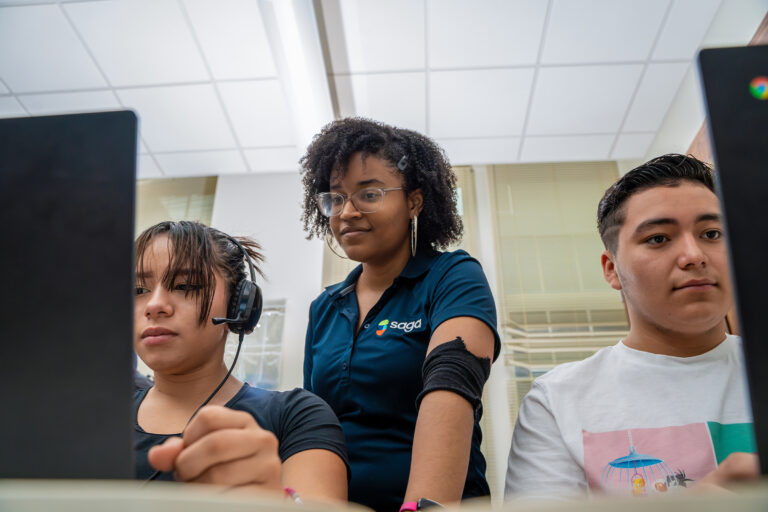
Research consistently shows that high-dosage, relationship-based tutoring is one of the most effective interventions to accelerate learning for students who are behind. The new federal guidance allows districts to make tutoring not a side program, but a core academic strategy. But here’s the challenge: not all tutoring is created equal. To deliver results at scale, tutoring must be:
- Integrated with district structures (not tacked on as an afterthought).
- Sustainable over multiple years, with capacity built inside the district.
- Measurable and transparent, giving leaders confidence in its impact.
This is where a trusted partner becomes essential.
Building High-Impact Tutoring Programs That Meet Districts Where They Are
At Saga Education, we’ve spent years working alongside districts to design tutoring programs that flex with operational realities while maintaining instructional integrity. We provide a roadmap that helps districts move from early implementation to full ownership.
Rather than a one-size-fits-all approach, our models adapt to district needs, schedules, and staffing.
Tutoring Delivery Models That Flex With District Needs
- Traditional, In-Person Model: Daily or near-daily tutoring embedded as a class period or intervention block. Ideal for districts prioritizing consistent, individualized instructional time.
- Blended Learning Model: Combines in-person tutoring with adaptive digital tools. Offers flexibility and affordability for districts with limited staff or space.
- Embedded Classroom Model: Tutors provide just-in-time support during core instruction. Best for districts seeking integration without major schedule overhauls.
- Live-Online Model: Virtual tutoring delivered through a secure platform, expanding staffing options and supporting multi-site scalability.
Each model reflects a core principle: tutoring should enhance, not disrupt, instruction.
Technology as Infrastructure: Building for Scale and Accountability
Compliance with federal guidance will require districts to demonstrate not only that interventions are in place, but that they are working. For chiefs of staff and operations leaders, this means systems matter as much as strategies.
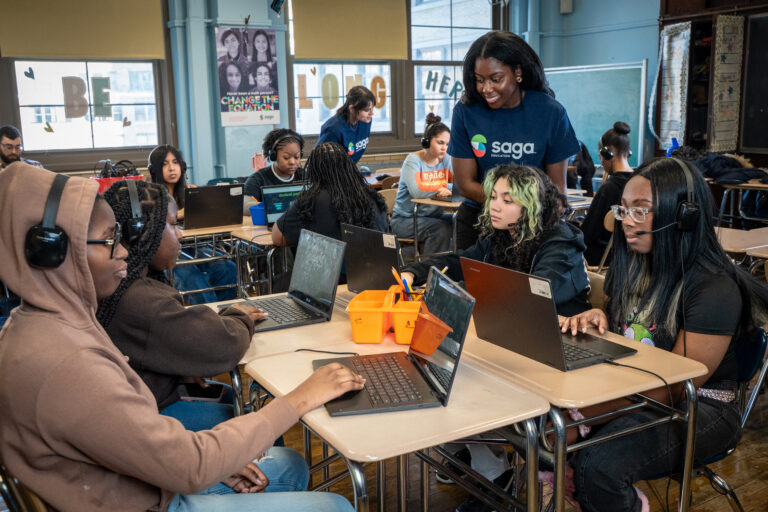
Saga’s platform was designed specifically for this purpose. It provides:
- Program management tools for rostering, scheduling, and attendance.
- Tutor training and professional learning embedded with feedback loops.
- Instructional delivery tools supporting in-person and online models.
- Progress monitoring dashboards with real-time engagement and learning data, plus AI-driven insights for continuous improvement.
This isn’t about layering another edtech tool onto schools. It’s about building the infrastructure for accountability, scalability, and sustainability — all essential for meeting the spirit of federal guidance.
A Phased Roadmap: From Build to Sustain
Perhaps the most important lesson from past turnaround efforts is that short-term fixes don’t last. Districts need a path from early adoption to long-term ownership. Saga’s phased model provides that trajectory:
- Year 1 – Build: Saga leads program setup and delivery, ensuring fidelity and early wins. District leaders begin shadowing and engaging in program management.
- Year 2 – Grow: District teams co-lead key functions. The program expands across schools, subjects, or delivery models, while Saga provides coaching and platform support.
- Year 3 – Sustain: District assumes complete ownership. Saga shifts to light-touch support, providing access to technology, data insights, and optional training. The district achieves ROI through increased student achievement and reduced cost per session.
This roadmap ensures that tutoring is not a temporary compliance measure but a durable lever for equity and excellence.
Why This Matters Now
Federal guidance provides an accountability framework. What students need — and what families are hoping for — is reassurance that districts can offer interventions that genuinely help all children thrive. High-impact tutoring, implemented with fidelity and supported by strong systems, can be a cornerstone of school turnaround. For chiefs of staff and operations leaders, it offers a path to align policy compliance with instructional improvement, fiscal responsibility, and long-term sustainability.
The moment demands urgency. But urgency without strategy leads to churn. By adopting a continuum of services, districts can respond quickly to federal expectations while laying the foundation for lasting change.
From Compliance to Transformation
Policy guidance can set expectations. However, transformation happens when districts have the tools, models, and support to translate mandates into student success.
Saga Education offers a roadmap for districts ready to take high-impact tutoring from pilot to policy-aligned practice, from compliance to capacity, from intervention to instruction.
For district leaders navigating the demands of federal guidance, the path forward doesn’t have to be uncertain. It can be structured, scalable, and sustainable.