
How Saga
Coaches
Tutors
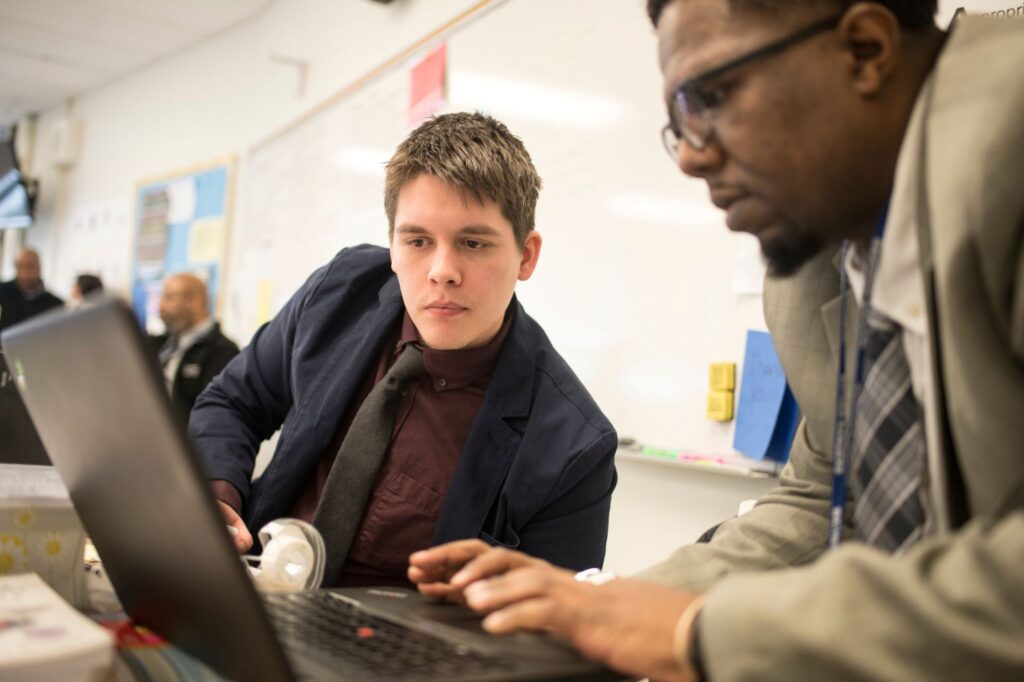
Saga develops tutors through one connected system: a shared framework for quality tutoring, a practice-heavy preservice training, ongoing learning tied to that framework, and a coach who helps each tutor turn learning into daily practice. Coaching combines in-person observation and feedback with an AI-powered tool that analyzes every tutorial.
Saga’s Approach
The design reflects what research says works. Sustained professional learning can lead to student gains (Yoon et al., 2007), especially when it is ongoing, collaborative, and connected to daily practice (Darling-Hammond et al., 2017). Coaching has been shown to meaningfully improve instructional quality and student outcomes (Kraft et al., 2018).
20
hours of preservice training before tutors meet students
7
skills in the Quality Tutoring Framework
70%
of the thinking, talking, and writing done by students
3
learning formats: Communities of Practice, asynchronous modules, and microlearnings
The Quality Tutoring Framework
The Saga Quality Tutoring Framework (QTF) is a shared vision of high-quality tutoring. It names seven skills tutors develop over time, grouped into three tiers and three domains: Culture, Student Mathematical Work, and Active Learning Community. Training, ongoing learning, and coaching are all organized around it.
| Skill | What it looks like |
|---|---|
| ● Positive relationships | Core skill. Routines, tone, and redirection that make students feel safe and valued |
| ● Appropriate task selection | Core skill. Rich, grade-level tasks taught with accurate content and well-used time |
| ● Cognitive lift on students | Core skill. Students do at least 70% of the thinking, talking, and writing |
| ● Strategic use of questioning | Leveling-up skill. Balanced questions and wait time that get students explaining their thinking |
| ● Responding to student needs | Leveling-up skill. Diagnosing unfinished learning and adjusting with asset-based feedback |
| ● Differentiation and scaffolding | Advanced skill. Individualized, inclusive supports that keep every student in productive struggle |
| ● Cooperative and collaborative tone | Advanced skill. Student voice, discourse routines, and a shared sense of success |
Math mindsets run through every skill. Tutors learn seven research-based beliefs about math learning, such as that everyone can learn math to the highest levels, mistakes are valuable, and depth matters more than speed. Coaches connect each skill back to these mindsets.
Each skill builds on the ones before it. Students take on more of the thinking when they feel safe being wrong, so strong relationships make cognitive lift possible. Good questioning surfaces the student thinking tutors need to respond and scaffold well. Collaboration is the integration of all the earlier skills: when they are strong, students working together becomes a natural outcome rather than a forced structure.
“Learning begins with strong student-tutor relationships. When students feel supported and safe being wrong, they’re more willing to take risks, do the thinking, and engage in the learning process. Relationships are the first and most essential ingredient in great tutoring.”
Halley Bowman, EdDSenior Director of Academics, Saga Education
Preservice Training
Before working with students, every tutor completes 20 hours of preservice training over five days. New content is introduced in short asynchronous modules of 30 minutes or less, and live synchronous sessions are reserved for practice and community building.
Grounded in purpose. Training opens by connecting tutors with peers, exploring the research on high-impact tutoring, and reflecting on their personal reasons for doing this work. Tutors return to that “why” at the close of the week.
Built on rehearsal. In the live sessions, tutors practice the moves they will use with students. In small groups, they take turns playing tutor and student, facilitate short tutorial segments with real math problems, and give and receive peer feedback before trying again. Practice covers opening and closing a tutorial, keeping the thinking with students, questioning to check understanding, planning and facilitating a full segment, redirecting off-task behavior positively, and using Saga’s online tutoring platform.
Focused on the core. Preservice concentrates on the core skills and questioning. Differentiation and collaboration are introduced so tutors understand where they are headed, with the expectation that they will grow into these advanced skills over the year.
Ongoing Learning
After preservice, tutors keep building their practice through a library of learning organized by QTF skill. Three formats let tutors go deep, apply one move quickly, or learn alongside peers. Each skill has three kinds of support.
Core Modules
About 30 minutes
A deeper look at the skill.
Microlearnings
Under 10 minutes
Each teaches one strategy tutors can use in their next tutorial, such as a discussion routine or giving precise praise.
Communities of Practice
Live, 45 minutes
Tutors come together to share wins and struggles and problem-solve real challenges with peers.
Some microlearnings spotlight experienced tutors sharing what works for them, and others model instructional routines through mock tutorials.
The Coach’s Role
Coaches help tutors translate what they learn into what they do with students. They work from a shared understanding of the training tutors received, so coaching picks up exactly where preservice left off.
Starting strong. In the first weeks, coaches use 1:1 conversations to get to know each tutor’s working style, confidence, and early support needs, and to learn about their students.
A cycle of plan, observe, and practice. Coaches help tutors plan specific moves before a tutorial, observe for evidence of those moves, and debrief afterward. Rather than only giving feedback, coaches rehearse a revised move with the tutor so it feels natural before the next session. When available, video lets tutors see their own moves, celebrate progress, and refine their practice.
Skill-specific guidance. For each QTF skill, coaches have targeted strategies and reflection questions, plus a map of how the skill connects to what came before and what comes next. This helps them diagnose root causes. For example, if students are not reasoning, a coach looks first at whether the task invites reasoning.
Shared tools. Tutors and coaches plan with the Tutorial Planning Tool, and tutors set focused goals with the QTF Self-Reflection & Growth tool.
AI-Powered Coaching Insights
Saga’s AI-powered tutorial analytics, built in partnership with the Learning Engineering Virtual Institute and University of Colorado Boulder, give coaches feedback on every tutorial, live-online or in person. Glows and Grows offer up to three QTF-aligned insights on productive moments and next steps. Session metrics track student talk ratio, wait time, and academically productive talk moves, and trends over time show tutor progress. One coach can support many tutors without sitting in on every session.