
Key Takeaways:
Pillars of Engagement: New Mexico’s high-impact live-online tutoring success stems from three key system design decisions: teacher-tutor collaboration, in-person site coordination, and a persistent focus on maximizing student talk time.
Optimizing Student-Tutor Talk: Tutor coaching is critical for engagement, emphasizing the need to replace closed questions with open-ended prompts that require students to explain their approach and reasoning.
In New Mexico’s statewide high-impact tutoring program, students learned 38% more than non-tutored peers after an average of 40 hours of tutoring in a live-online environment. Many districts’ experiences with virtual learning during the Covid pandemic affected how they view the impact of live-online learning environments on students and learning outcomes. Others worry, can students stay engaged in an online environment, and what does that look like?
As New Mexico Public Education Department’s (NMPED) Accelerated Learning & Professional Development Project Manager, Michelle Korbakes coordinates the state’s high-impact math tutoring program. Since 2022, NMPED has been a participant in the Personalized Learning Initiative (a partnership led by the University of Chicago Education Lab and MDRC). The program uses the nonprofit Saga Education’s high-quality math tutoring curriculum, and Saga Education, a national nonprofit, provides technical assistance support and tutor training and coaching. The state has hired its own live-online tutor corps.
Korbakes attributes the state’s success with high-impact tutoring to three system-level design decisions:
- collaboration between teachers and tutors,
- the on-site coordinators to help support students,
- and a persistent focus on coaching tutors to let students do more of the talking in tutorials.
Aligning Classroom Instruction and Tutoring
For teacher and tutor collaboration, alignment is a key component and accelerator of student outcomes. Korbakes says a communications log (a spreadsheet) acts as the connection between what’s happening in the classroom and the tutorial.
“The teachers go in the spreadsheet weekly and share what they’ve been working on in the classroom and provide feedback to the tutor where students are struggling,” Korbakes says. “Then they give tutors the Saga lesson that they want tutors to use in their session.”
This ensures that students are engaged in learning content that’s directly aligned to what they’re learning in the classroom.
Blending Live-Online Tutoring with In-Person Oversight
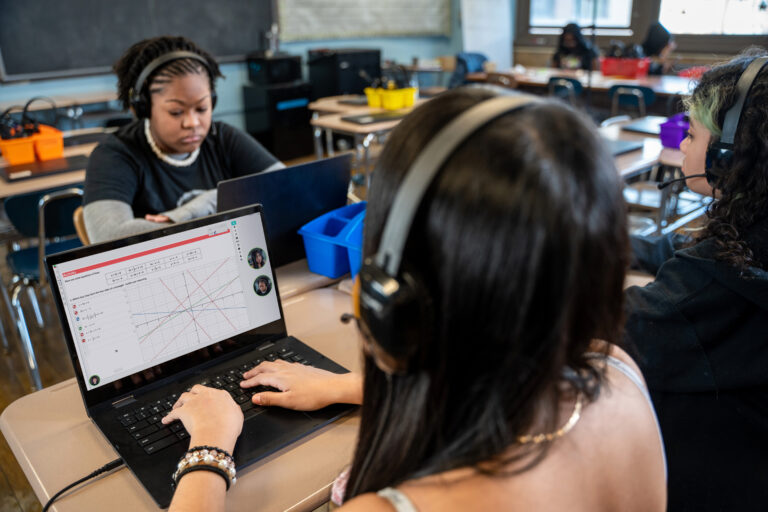
Because high-impact math tutoring in New Mexico is delivered by tutors in a live-online setting during the school day, students log on to tutoring in school classrooms and are monitored by a site coordinator or proctor who helps ensure technology is working and students stay on task. Site coordinators play a key role in keeping students engaged, ensuring technology like microphones and cameras are working, and redirecting students when they get distracted. These coordinators, who are often math teachers in the school, ensure students stay focused in the tutoring lab.
“Middle school students can be engaged through the online platform, but it takes the tutor building a relationship and whoever is in the room with them to ensure they’re on task for it to be a productive session,” Korbakes explains.
Using Student Talk Time to Drive Engagement and Learning
Increasing student-to-tutor talk ratio is the third pillar of New Mexico’s success–and one that is an ongoing focus of the coaching that the state and Saga provide to tutors. “We are constantly telling our tutors–this is just a work in progress all the time–that they are not the ones doing the talking, that students need to be doing the majority of the talking,” Korbakes says. This year, the program’s tutorials are all occurring in Saga Connect, which provides not only student-to-tutor talk ratios, but a myriad of additional signals that they use to help coach the tutors. And this type of analysis is hard to replicate in an in-person tutorial.
The time tutors actually talk compared to the time students talk is one of the first measures of engagement they optimize for, since getting the students to do the heavy lifting is critical to learning. “We try and reiterate to our tutors, don’t re-explain the math, have students explain it,” she adds. So the live-online platform makes this ratio, along with other key aspects, front and center for both the tutor and coach.
Coaching Tutors to Ask Better Questions
One way New Mexico operationalizes student talk time is by coaching tutors on question quality.
Good questions often have the biggest payoff for increasing engagement. “When we were watching tutorial sessions, I heard tutors asking closed questions, like ‘Are you good?’
‘Everybody got it?’ ‘Thumbs up if you got it.’ And that tells us nothing about students’ learning and whether they really understand what you’ve said.” Korbakes tells tutors to take those phrases out of their vocabulary. Instead, more productive, engaging prompts look like this:
- “Explain to me how you got your answer.”
- “Tell me what the next step would be.”
- “Tell me how your approach was different from [classmate’s name].”
She says that this approach positions students to take the information, interpret it, and share it back with the tutor and fellow students. Korbakes also notes that the tutor’s own level of enthusiasm, engagement, and interest in students’ lives and work also are key differentiators for student engagement.
Rethinking What Engagement Looks Like in Live-Online Tutoring
Tracking student engagement online presents unique challenges and opportunities. At times, when observing online tutorials students may appear off task, she points out. For example, a student may look as if they are not paying attention, but they may be taking notes as the tutor is talking. Students may also be typing their answers on slides in the platform or in the chat box, something that’s also harder to observe virtually.
Engagement challenges can be more visible after students return to school after long breaks. The Learning Disabilities Association of America points out that students’ often have different routines on holidays, staying up later and sleeping in. In New Mexico’s case, students and tutors take the entire month of December off. So, Korbakes encourages tutors to ease students back into tutoring with activities to rebuild trust and relationships, not diving right back into academics.
Engaging students in learning is a shared responsibility, Korbakes says. “If you think you’re going to just come in and have tutors deliver instruction without thinking about the teachers providing feedback and the adult in the room to help manage students on site, you’re missing a good portion of what a good tutorial session should be,” she says.
Ultimately, success in high-impact math tutoring is about designing conditions where learning happens, even when it might look different from what’s expected.
Saga partners with districts to make that success measurable and scalable