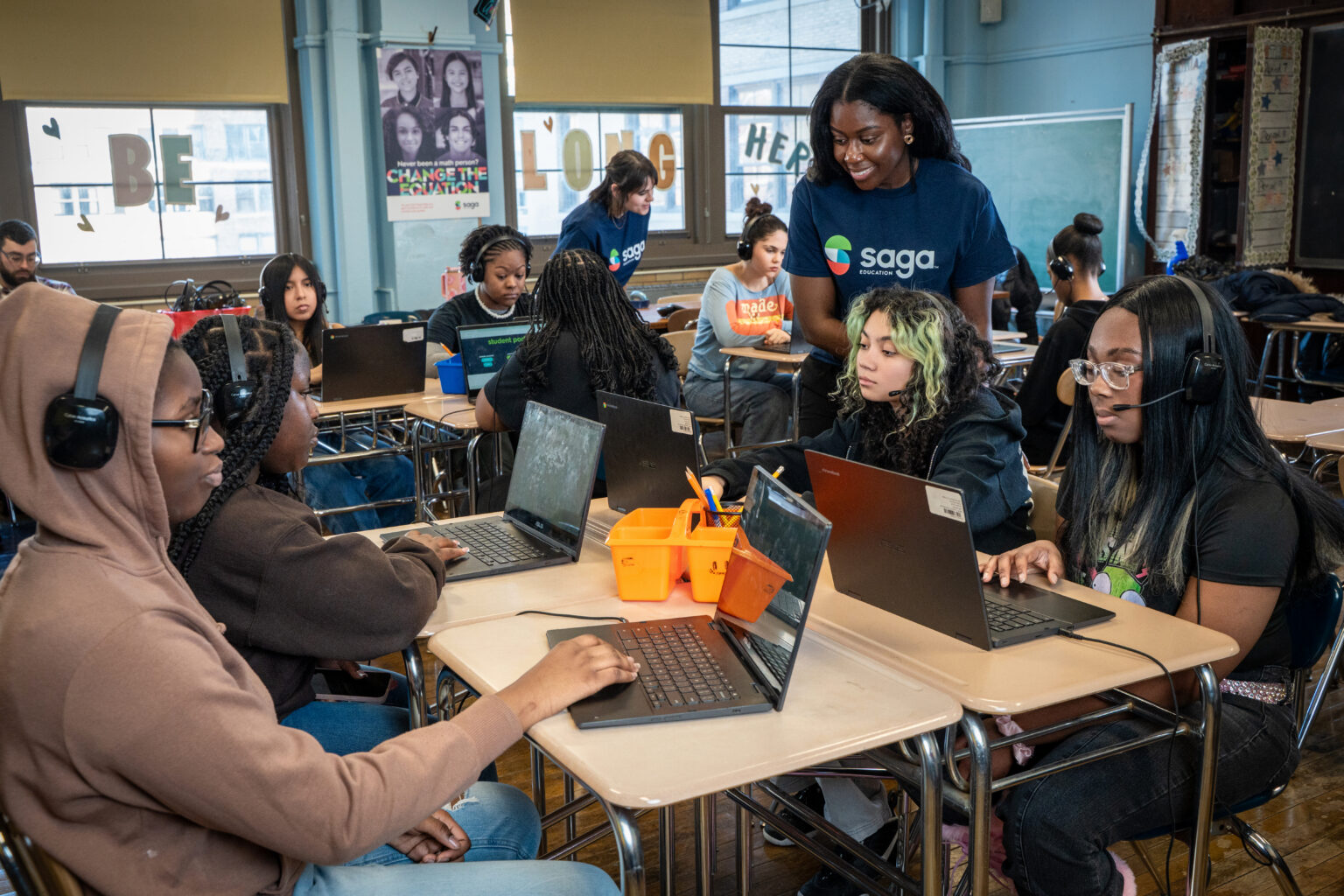
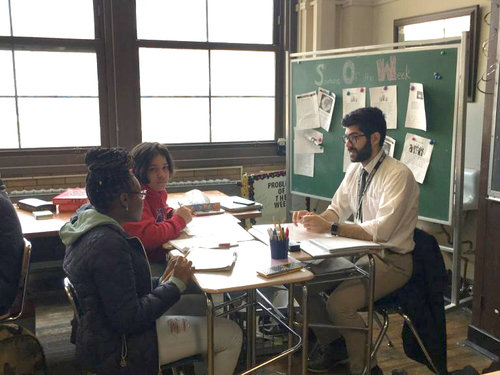
For eight years, the partnership between Saga Education and the High School of Fashion Industries (HSFI) in New York City successfully built and sustained a high-impact tutoring program. Saga’s Math Lab became a “home” for students and played a significant role in raising math achievement at the arts-focused school.
In the heart of Manhattan, HSFI has built a strong legacy as a place where students explore careers in fashion, the arts, and design. In 2024, it served over 1,450 students, with more than 80% coming from economically disadvantaged backgrounds. Serving over a thousand students during that period, the program’s success led to increases in students advancing to upper-level math classes like AP Calculus and AP Statistics. In the 2023 and 2024 school years, HSFI students who attended Saga-led tutoring had a 94 percent pass rate in their core Algebra I classes.
This long-term relationship ended in 2025 when funding for the high-impact tutoring program ran out, mirroring the difficult decisions districts and nonprofits have faced since federal funds have expired. Saga Education spoke with Shannon Kohm, Assistant Principal of Mathematics at HSFI, who shares his first-hand perspective on building that critical support and the challenge of sustaining those gains without it.
Shifting the Mindset: Math at an Arts-Focused School
Saga Education: Can you provide some details about your background and the challenges you faced leading the math department at the High School of Fashion Industries, where students are primarily focused on arts and fashion majors?
Shannon Kohm: I’ve been at HSFI since 2010, and this is my 16th year as assistant principal of the math department. Before that, I worked for 11 years at a high school in Queens. When I came to HSFI, I was looking for a school with a larger department where I could serve in a more traditional department supervisor role. At HSFI, we have 20 teachers in our department, which allows for much greater collaboration over curriculum and supporting students.
Our community is truly unique. The kids don’t come to Fashion for the math classes; they come because of our majors. They want to learn how to make garments or pursue their art interests, but all students are required to take their core high school classes. It’s a challenge: I have to find a way to show students that there is a place for creativity in math and that there is an overlap and application in many of their major classes. For me, I want to make sure that the students who go through fashion have a strong foundation in all their disciplines so they don’t put all their eggs in one basket and can pivot at any time.
The Initial Challenge and the Need for Intervention
Saga Education: When you started at HSFI, what was the main challenge in the math department that signaled you needed a specific intervention like high-impact tutoring?
Shannon Kohm: When I first came to the school, there was a lot of focus around supporting the lower-achieving students or students that had math deficiencies. There are a lot of kids who self-identify as “not a math person.” They would come to our school already deficient. The universal remedy being applied was extra classes. For example, half of our students were on a track to take two years to complete algebra, which was mind-blowing. All these kids were being steered into a path where they were mathematically being eliminated from taking any upper-level math classes, putting them at a huge disadvantage for college applications.
I immediately did away with that path and introduced a whole bunch of AP classes. We realized that some kids need support, but we shouldn’t assume they need an extended curriculum sequence right from the first day. I started to realize that extending algebra over two years wasn’t the way to give support. That dovetailed perfectly with my learning about Saga. This was a way for us to provide additional support for students during their freshman year—without predetermining their path—allowing them to remain on track for a standard sequence of courses and still be candidates for advanced placement classes.
Flexibility and Partnership in Practice
Saga Education: When starting with an external partner, there can be curriculum alignment challenges. What was the process for integrating Saga into your school’s curriculum and operations?
Shannon Kohm: We partnered with Saga for a good amount of time—I want to say eight years. We experienced different iterations, starting with all in-person tutors, which was our favorite, and then moving to hybrid and remote models. Regardless of the model, Saga coaches, leadership, and support people were always responsive. They had a ready-to-go, well-thought-out curriculum that served as a default and a backstop, but they weren’t so rigid that they weren’t open to being responsive to our needs. They viewed their program and coaches as being a part of our team.
We would meet with them at the beginning of the year and invite the Saga staff into our weekly focus group and planning sessions. This allowed them to know in advance what topics we were going to be teaching. They would use diagnostics and sometimes go a little bit ahead of where we were. For instance, if a unit was coming up that required simplifying radicals, they might review that beforehand to get kids geared up, saving our teachers from having to stop and do a whole bunch of review. It was extremely helpful because they would talk to the teachers, ask what was expected to be a problem, and provide real-time interventions, additional practice, and anticipatory review. They were just always flexible and adaptive.
Measuring Value and Outcomes
Saga Education: What specific outcomes—both hard data and other observable evidence—convinced you of the value of high-impact tutoring?
Shannon Kohm: We saw both higher pass rates and higher Regents exam results. When we did scholarship analysis, we saw that kids were more successful in their algebra class itself.
In addition to the hard data, we saw other evidence of the impact. When I would observe teachers, I would see students who normally would have been reluctant raising their hand and excitedly sharing out the response, and then saying out loud, “Oh, my Saga tutor taught me that!”. I used to see that all the time, and they would say it very proudly. You would notice a difference in the self-confidence of the kids, that they had learned something and overcome something. They would say, “Oh no, I can help with that,” or, “I learned how to do that before” when their peers were confused. The soft data—seeing kids being happy, enthused, and engaged in that class—was observable without question.
Building Buy-In and Impacting Attendance
Saga Education: How did you ensure consistent student participation and buy-in, and did you see any impact on student attendance or absenteeism?
Shannon Kohm: Definitely. Student attendance was definitely higher for students that were enrolled in Saga, for sure. There’s a mentorship angle to this; when you have a tutor working with you in a one-on-one manner, the students feel compelled to be there to not let that person down.
Regarding buy-in, we didn’t make it optional; we programmed the students for it right from the beginning. When they got their ninth-grade schedule, it was there.
The Saga staff also does an amazing job of creating an environment that is fun to be in. The tutors they hire are young, energetic, and relatable to teenagers, and they make the atmosphere fun. There are decorations, brain breaks, fun celebrations, prizes, and awards. It was its own little community, with its own vibe, and it became a place that kids would go to spend their free period or lunch and connect with the adults working there. It’s a huge testament to get kids who aren’t “math people” to stay interested and connected with the program.
The Long-Term Effect and the Funding Challenge
Saga Education: What was the long-term impact on your math program, and what consequences have you observed since your school stopped offering high-impact tutoring due to funding ending?
Shannon Kohm: We’ve seen a large growth over the last 10 years or so in the enrollment of students in upper-level math classes. When I first started, half the students weren’t even taking geometry; they were just doing algebra for two years. We now offer Pre-calculus, AP Pre-calculus, AP Calculus, and AP Stats. Saga helped to ensure that a large number of students stayed on track and were successful enough to make it to those classes, and also had enough of a foundation and self-confidence not to be intimidated in taking AP classes.
Since the funding was pulled, we’ve had to revert back to what we did beforehand. Unfortunately, you see a lot of teacher burnout because they are asked to do so much. Our teachers are doing a lot more tutoring during their lunch periods and offering support. We’ve instituted “no new teaching” days every two weeks for reteaching, remediating, and giving feedback. While this is good practice, it’s clear that teachers feel more overwhelmed trying to pick up that heavy burden. When you have 25 kids in a room and you’re one adult, it’s hard to meet those needs—which is where Saga was so helpful. They miss having the Saga staff there to help pull the rope in the same direction.
Saga Education: What do you think is required to secure the long-term funding necessary to bring this type of high-impact tutoring back to schools like HSFI?
Shannon Kohm: It’s really something that needs to be championed by people above the school level, such as the district folks or the chancellor’s office. Those are the folks that have the ability to allocate the resources to provide this type of service. Within the school budget, it’s not easy to come up with the funding to support a program at the scale it needs to be, like providing regular tutoring to 200 kids with a ratio of one tutor for every two students.
Schools can fund after-school or weekend math tutoring, but those sessions usually have a lot of kids and are only a couple days a week; that’s not the same thing as providing it every day.
Bridging the Gap: Why In-School Tutoring is Essential for Commuter Students
For veteran Algebra I teacher Jeanne Klepacki, high-impact tutoring like Saga’s helped provide a boost for students entering the high school who were behind grade-level in math learning. Some students told her that their teachers in middle school left mid-year and their schools struggled to replace them. It’s “really hard to get those kids caught up” without extra support, she explained.
Klepacki joined the New York City public High School of Fashion Industries staff in 2000, working in the attendance office and teaching math, after three years teaching math at a Catholic school. She returned to teaching algebra after COVID and observed students in her classes who participated in Saga’s tutoring at HSFI.
Students who thrived in Saga tutoring saw their performance carried over into their classroom grades, she said. The small group setting and individual attention allowed Saga tutors to focus on exactly what challenges students faced and “how to help them best,” she said. Saga staff participated in weekly teacher meetings to keep track of what students were learning in classrooms to align tutoring with teacher lessons.
“”There were some kids who really liked Saga. They thought that Saga was very helpful and you can see a difference with them,” she said. “If they learned a topic before I got to it, they would be so excited like, ‘We did this in Saga!’”
Jeanne highlighted a common challenge for schools like hers in urban areas: “the problem with a commuter school is that in the fall a lot of parents don’t want their kids to stay after school because it’s dark and they don’t want them coming home in the dark.” This commuting constraint makes traditional after-school support less accessible, underscoring the vital role of in-school-day tutoring—a key feature of the Saga model.
Jeanne confirms the value of the program: “If there was Saga this year, it would have been so helpful because this year’s class is showing more of a deficiency than I’ve seen in a while.” Without Saga, teachers offer tutoring during their lunch breaks and during their free periods.
“I believe student grades were better for those enrolled in Saga,” Klepacki said. “It definitely helped, and I saw a clear improvement in performance for students who had Saga compared to those who didn’t.”
When high-impact tutoring is embedded during the school day, it can remove barriers and ensure more students get the consistent, individualized support they need to not just catch up, but to get ahead.